Saturday, September 27, 2014
Enterovirus D68. The new polio?
News from CDC
is that there have been more cases of a strange paralytic syndrome in children
in which limbs go limp following what appears to be an upper respiratory
illness (http://emergency.cdc.gov/han/han00370.asp).
Some, but not all, of these children have tested positive for Enterovirus D68
(EV-D68). The cluster announced yesterday is in Colorado and involves 9
children. Earlier this year California reported twenty cases of the same
illness that had occurred over a 2-year period (http://www.nytimes.com/2014/02/26/health/unknown-form-of-paralysis-strikes-california-children.html?_r=0).
So, has polio
returned in a new guise?
I am not old
enough to remember polio. I remember receiving the oral vaccine and seeing old
black and white newsreels of children in iron lungs, but no one I knew had contracted
the disease. Even during my training I didn’t see a case. Although the disease
is believed to have been around since Greco-Roman times, it wasn’t until the
late 19th and early 20th centuries that humanity was
plagued by epidemics. Like EV-D68,
polio belongs to the enterovirus family and is transmitted person to person via
the fecal-oral route. Believe it
or not the epidemics of last century are attributed to improved hygiene. With
less exposure to the virus during infancy there was a decline in immunity that
resulted in a more severe illness later in life when exposed. Most polio
infections (95%) are inapparent, meaning they don’t result in any symptoms or paralysis,
yet the person is capable of transmitting the virus. Among those with symptoms only
about 1% get paralysis. To any individual the risk was low, however, on a
population scale this was disastrous. During the peak years there were about
20,000 cases of paralytic polio per year in the US. After vaccine was
introduced in the 1950s there was a dramatic decline and polio in the United
States was all but forgotten.
I was
speaking to a public health historian the other day. She told me that when she
was in graduate school she was told that infectious diseases had been conquered
and that it was pointless to study them. Chronic disease was the new frontier. Short sighted to say the least. Ebola,
Legionnaire’s disease, HIV, Hantavirus, SARS, Nipah and MERS have all emerged
since this professor was told to forget about the field. West Nile virus moved
into a new hemisphere, we’ve had an influenza pandemic and Chikungunya exploded
in the Caribbean. Forget what you were told, infectious diseases will be with
us as long as there still is a planet earth.
Consider
this. Your 4-digit PIN number has 10,000 possibilities. There are ten options
for the first digit, i.e., zero through nine. Since one can repeat numbers there
are also ten options for the next three digits. That’s 10x10x10x10, or 10,000. A computer program can run through every
possible PIN number very quickly. Supposing a thief had a program that could
submit the guessed PINs to your account. It wouldn’t take long before he or she
was staring at your account balance.
Now consider the
ever-changing world of nature. Instead of PIN numbers we are talking about the
genetic code, large sequences of DNA or RNA. Each location is like the digit of
a PIN number. Nature is like a huge supercomputer, changing the genetic code
constantly. The change here is a mutation and instead of allowing access to
your bank account the mutation of concern is one that improves the organism’s
chance of survival or increases virulence. Millions and millions of mutations
don’t, but by chance alone, sooner or later, a mutation is going to result in
is a more virulent organism or one that can cross species. This is why there
will always be new infectious diseases on the horizon. EV-D68 is a RNA virus.
RNA viruses are more prone to mutation (influenza for example). But has EV-D68
somehow mutated to become a paralytic virus like its cousin polio? We don’t
know yet. Right now the occurrence of paralysis is quite rare.
Saturday, September 6, 2014
Meningococcal disease in young men of color, Brooklyn, New York
Meningococcal disease is
a severe bacterial infection often called “spinal meningitis” or just
“meningitis” by the media. Although it can spread from one person to another it
is not as contagious as the popular press makes it out to be. Household
members, sexual contacts and persons who share cigarettes or drugs are at the
highest risk for catching the disease which is potentially deadly, claiming as
much as 20% of victims. There is good news though, there are vaccines for
meningococcal disease.
Meningococcal disease can
be insidious. Often it looks like the flu at first, with fever, sore throat, chills, muscle pain and
just feeling punky. A rash might develop which looks like small red dots that
don’t go away when pressed with a finger (known as blanching). If meningitis
develops these signs are much easier to recognize: headache, stiff neck, eye sensitivity
to light, vomiting and a fogginess of mind. If you have any of these symptoms
don’t delay. Especially if you have HIV. Contact your physician. This disease is readily treatable with simple antibiotics.
NYC has had two large
outbreaks of meningococcal disease in the last decade. One in 2006 and another
in 2011-2013. Both outbreaks were centered in Brooklyn, specifically the
neighborhoods of Bedford-Stuyvesant, Crown Heights and Brownsville. The most
recent outbreak affected men who have sex with men (MSM), many of whom were
HIV-infected. The outbreak was thought to have been conquered in February 2013
but there have been 4 recent cases in HIV-infected MSM prompting new concerns
and efforts to quell the disease. It is not yet known exactly how the disease
is moving through the community but there is some evidence to suggest that
multiple anonymous sex partners and sharing of drugs is involved.
The response to these
outbreaks has been vaccine campaigns. One issue is that the vaccine’s
effectiveness in HIV-infected is unknown and two of the recent 4 cases had
been vaccinated with the recommended two doses. Still it is better to be vaccinated,
as there may be some level of protection and prevention of the most serious
outcome. Death.
Another issue is that
there is a population of young men who are bisexual or not openly gay who have not
gotten the message about vaccine. Many of the recent cases fall into this
group. This is where the greater community can help. If you know someone who is
at risk for meningococcal disease tell him or her about the vaccine. Urge them
to protect themselves. Friends and family want them to stick around, so perhaps
they’ll do it for you. One needn’t announce their sexual preferences to receive
vaccine. Walgreens/Duane Reade and CVS pharmacies will give the vaccine no
questions asked. Check to see that your local pharmacy has it in stock or where
the nearest store with the vaccine is located. For those without insurance, you
can visit one of the City’s free clinics. The Fort Greene location has Saturday
hours. There will be a free vaccine event Sunday (September 7, 2014) at the 3rd
annual Bushwig event. Look for the van near the venue at 389 Melrose Street, Brooklyn.
Lastly, don’t allow fear
to paralyze you into inaction.
Labels:
AIDS,
Bushwig,
HIV,
men who have sex with men,
meningitis,
Neisseria,
vaccine
Monday, September 1, 2014
Ebola won't be a pandemic
Between 2,000 and 5,000 travelers arrive monthly in the New
York City metropolitan area from the West African Countries currently
struggling to contain the Ebola Virus outbreak. It is highly unlikely though
that an individual infected with the virus will arrive here without the medical
community knowing about him or her.
Any passenger found to be sick on the flight would be reported to the
CDC Quarantine Station by the flight crew and whisked into isolation with full
infection control precautions in place. If the illness starts after arrival all
emergency departments are prepared to isolate the sick traveler and determine
the etiology of the febrile illness. Typhoid fever, cholera and malaria are
infinitely more likely than Ebola.
Of the fifty or so people who have arrived in NYC from West
Africa sick none have even had an illness worrisome for Ebola let alone the
disease. This includes the well-known patient at Mt. Sinai. Should a patient with
Ebola arrive in NYC there would still be little reason for the general public
to be concerned. The primary transmission risk for Ebola is to health care
workers who do not have adequate personal protective equipment and persons
handling infected bodies during burial rites. The health care systems in the
affected countries are both understaffed and under resourced, a problem not
present in NYC (or anywhere in the US for that matter). NYC has the ability to rapidly test
suspect patients, something that isn’t easily done in West Africa. Additionally,
Ebola, unlike say measles, isn’t contagious until after symptoms begin, so
there is time to implement control measures. Ebola isn’t airborne so to be
infected one needs to come in contact with body fluids. The risk of Ebola transmission
is low during the beginning of the illness, therefore hospital infection
control precautions can be put in place in time and reduce the risk to health
care workers. Ebola just isn’t the type of disease to pose a risk to the
general US population. It’s not the Andromeda strain.
Monday, August 25, 2014
New Book The Ratcatcher and the Mole is Coming Soon!
Book three in the Mackey Dunn series is the prequel to Mailaise and introduces Mackey as the protagonist. The story is told through the eyes of Will Benes, a CDC pubic health trainee assigned to the woeful River City Department of Health. Will is the literary nephew of Holden Caulfield, and is a few shavings short of a chip off the old block. In Mackey Dunn he finds a kindred spirit and the only person whose misfortunes seem worse than his own.
Wednesday, January 9, 2013
Open the door and influenza
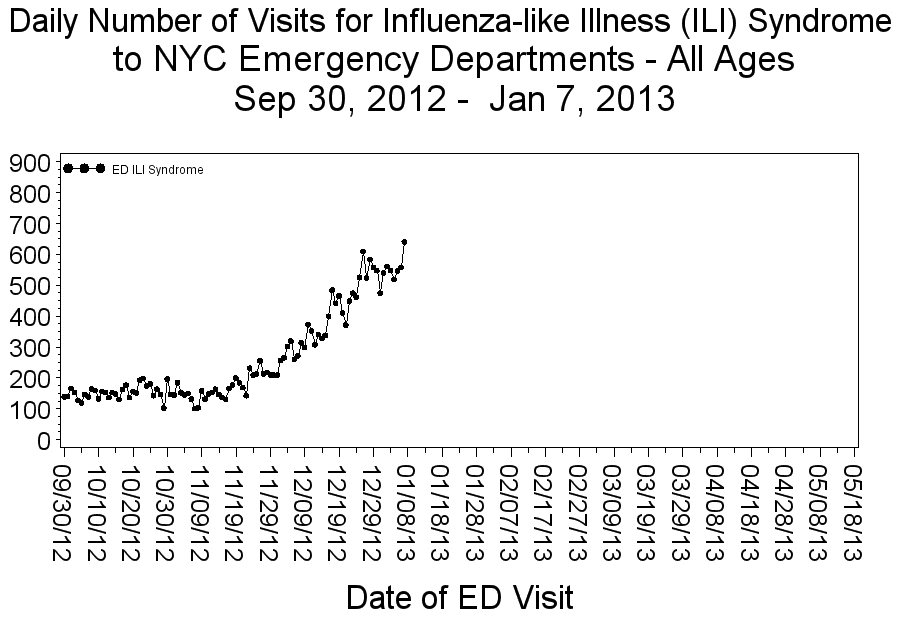
Influenza is here. Starting a few weeks before the holidays it began creeping up, not only in water cooler conversations and in sick call phone messages, but in emergency departments and physician's offices. So much so that people began to suspect something was amiss. Is it a new strain? Is there a problem with the vaccine? Today the City of Boston declared an influenza emergency because their hospitals are inundated with flu patients and the intensive care units are full (see link below).
http://gma.yahoo.com/blogs/abc-blogs/early-flu-season-hits-hard-224805500--abc-news-wellness.html
The story in NYC is a bit different. Sure, we've got flu, and plenty of it. One measure used is the number of long-term care facility outbreaks and we've already exceeded the number from all of last season. But thus far doctors and emergency departments are handling the load. If fact, the volume isn't unusual for peak flu season, the issue is that we've forgotten what a normal flu season is like. Last year flu barely touched down in NYC and cases were mild. In fact since the pandemic in 2009 we've had mild flu seasons, so we've forgotten what a mean flu season is like. The strain circulating this year is of the H3 variety, more severe than H1, and it arrived earlier than usual by about a month or so. The strains included in the vaccine are a good match so there isn't concern that the vaccine is any less effective than usual. Trouble is that flu vaccine doesn't work as well in the folks who need it the most, the elderly. But there are other things we New Yorkers can do to protect ourselves and our loved ones.
First and foremost, get yourself and children vaccinated. This will most likely protect you and if you do get ill it will be less severe. Your flu vaccination protects other family members and loved ones, because if you don't get sick you can't give it to grandma in the nursing home. Second, stay home when you have flu symptoms (fever, sore throat, cough, chills). No sense spreading the misery. This goes the same for kids too. And by no means go visit grandma if your are sick. She and her friends are vulnerable to flu and its complications. Wait until you're better. She'll miss you, but then she still be around for your next visit. Flu does kill, up to 50,000 Americans each season, and most are at the extremes of age. Also a good idea if you are not too sick to stay out of the emergency department or your doctor's office. Now if you are pregnant, have a chronic disease or respiratory problem then you should be in contact with your physician at the first symptom, otherwise, tough it out and keep your snot to yourself.
Oh, and don't forget to cover your cough and wash your hands!
Saturday, December 15, 2012
The awful legacy of meningitis
Perhaps no illness strikes fear
like meningitis (often referred to as spinal meningitis). I recall during my freshman year in high school that there was
a case in a neighboring town. The kid died and when we learned he was a
wrestler parents and teachers claimed it came from the mat. We were so frightened of the spongy
devil that I swapped my spot in the gym class wrestling line so that I was
matched up with one of the less athletic kids. That way I could pin him in
under a minute and get the hell off the grimy Petri dish.
There are many types of
meningitis. The previous post was
about fungal type, a rare form and related to pain injections. New York City
has thus far escaped having any cases. The most common type of meningitis is
caused by any number of viruses, but the type of meningitis that provokes
community wide anxiety, rumors and regularly makes its way onto the evening
news is a particular type of bacterial meningitis. It too is rare but possesses
two features that have earned its deserved reputation. The first is that it can
spread in group settings, such as schools. The second is that it kills. About one
out of six or seven victims die, rather high in the modern era of public health
and medicine. The name of this modern day scourge is meningococcal disease. The
bacterium responsible is called Neisseria
meningitidis. My job is to track and stop it.
The city is now in the midst of an
outbreak. Not an epidemic of the scale of AIDS or Swine flu. There have been
two dozen cases this year, but five have died. At the center of the outbreak is
the community of men who have sex with men and reside in several Brooklyn
neighborhoods. The health department has been promoting vaccination but it has
been hard to reach the people that most need it. More efforts are being made to
get the word out to those at highest risk.
Family legend is that my
grandfather died of meningitis. I was shy of my second birthday when he died so
I don’t have any memories of him other than from photos and the items from his
medical practice I found in my grandmother’s Grand Concourse apartment. He was
a physician and the story told me by my mother as long as I can remember was
that he could’ve been saved if they had just given him sulfur. I was already my
way to becoming a junior chemist and didn’t quite understand how the yellow
powder I had used to make gunpowder would’ve saved my grandfather. Last year I
decided to investigate the family story, learn if my grandfather really died of
the disease that it is now my job to watch over for the city. It took a few
months but I managed to get his death certificate from vital records. He died
at sixty-six, just a year or two after retiring from his Bronx medical practice
due to hearing loss. The certificate didn’t list the cause of death, however, the certificate had the name of the physician who attended his death. It was a long shot, but I tried to
locate him. The New York State Department of Education, the agency that
oversees physicians, maintains a website where people can verify licenses. I
found the doctor listed. He had graduated medical school in 1957. That made him
at least 80 years old, if he was still alive. The last known address was in
California and the Internet had two doctors with that name in the town listed
in his license record. I dialed the first number and a woman answered. She
confirmed I had the right physician. But his hearing was too poor to converse
by phone. If I would write a letter, he’d be happy to answer my questions.
Meanwhile I learned that the
city’s office of vital records had a more detailed death record. I got my dad
to sign the authorization form for his father’s record and requested the full cause
of death report. I had almost forgotten about it when the letter showed up a
few days before Christmas last year.
I poured over the report. Laboratory
diagnosis wasn’t common when my grandfather Jack died. I would have to confirm
my suspicion without the definitive evidence I was accustomed to having. Jack had
pneumonia and blood poisoning confirming that a bacterium was responsible. But
was it the notorious Neisseria meningitidis?
And then there it was, listed under the Part II. Other Contributing Conditions.
Printed in black ink by the hand of the physician who was at the bedside were the words Waterhouse-Friedrichson
Syndrome. It was the eureka
moment. Waterhouse-Friedrichson Syndrome is hemorrhage into the adrenal glands
and occurs in overwhelming bacterial sepsis, most notably that caused by Neisseria meningitidis. Sulfur, more
correctly the family of sulfonamide antibiotics, would have cured him. If they
could’ve treated him quickly enough. That is the thing with meningococcal
disease. You don’t have much time. I did end up getting a nice letter back from
the California doctor. He had no
recall of ever treating a case of meningococcal disease. I didn’t ask him if he
remembered treating grandfather Jack.
There is a vaccine for
meningococcal disease. Because of questions about its efficacy and cost
effectiveness, the CDC Committee on Immunization Practice only recommends the
vaccine for teenagers up through the college years because studies have shown
they are at an increased risk, particularly if they reside in dorms. But data
from NYC suggests that people living with HIV and AIDS (PLWHA) are at an even
greater risk. Currently there is a particularly nasty strain circulating among
the MSM community and we've worked to insure that vaccine is available to this population at most health centers and city run
clinics.
A few years ago there was a
meningococcal death in a high school student. The circumstances around the case
were particularly heart wrenching.
If you, a friend or a loved one is in the risk category, please get them
the message to get vaccinated.
Monday, October 8, 2012
Compounding Pharmacies
The official case count is up to 105 in the largest outbreak
of fungal meningitis in US history, but it will undoubtedly go higher as more
cases are recognized as being connected to the contaminated medicine (CDC
currently is updating the case counts once a day).
Fungal meningitis is the rarest form of meningitis and it is
not contagious from one person to another. It usually occurs only in people who
have a damaged immune system, like those with AIDS or undergoing chemotherapy. I
heard a TV interview by a doctor, not a public health official, but an
infectious disease specialist. He said we’ve never seen anything like this
before. Well, he’s not exactly correct. A few years back there was an outbreak of
Pseudomonas fluorescens traced to a
compounding pharmacy in Texas. It involved kids with serious diseases, like
cancer, who had indwelling catheters that required periodic flushing wit a
heparin preparation to keep them from clogging. See http://cid.oxfordjournals.org/content/47/11/1372.full.pdf
What are compounding pharmacies? They are a lot like the big
factories that produce food for retail stores. They buy large quantities of medication, like steroids, then
mix them with sterile water or another solution and prepare vials for doctors.
They exist because they can produce the drug at a cheaper price than pharmacies
with more rigorously oversight. The problem is that organisms, mostly bacteria
and fungi, have a way of getting everywhere. Unless you use high tech systems
to ensure absolute sterility mistakes like this can happen. Just like one
contaminated cow can be spread E. coli
to a lot of ground beef one unsterile step in a compounding pharmacy can
contaminate a lot of medicine.
What is odd and concerning is that the injections of steroids
into the spinal column is resulting in meningitis. The goal of the procedure is
to inject the medicine around the nerve root as it emerges from the spinal
cord. Decreasing inflammation by
the use of steroids will reduce pain. Most of the time the placement of the
needle is checked with fluoroscopy and dye. The spinal sac is not penetrated,
which means that the infections in the outbreak are a result of direct fungal invasion
though the spinal cord membrane or via the bloodstream. Both scary situations.
Subscribe to:
Posts (Atom)